
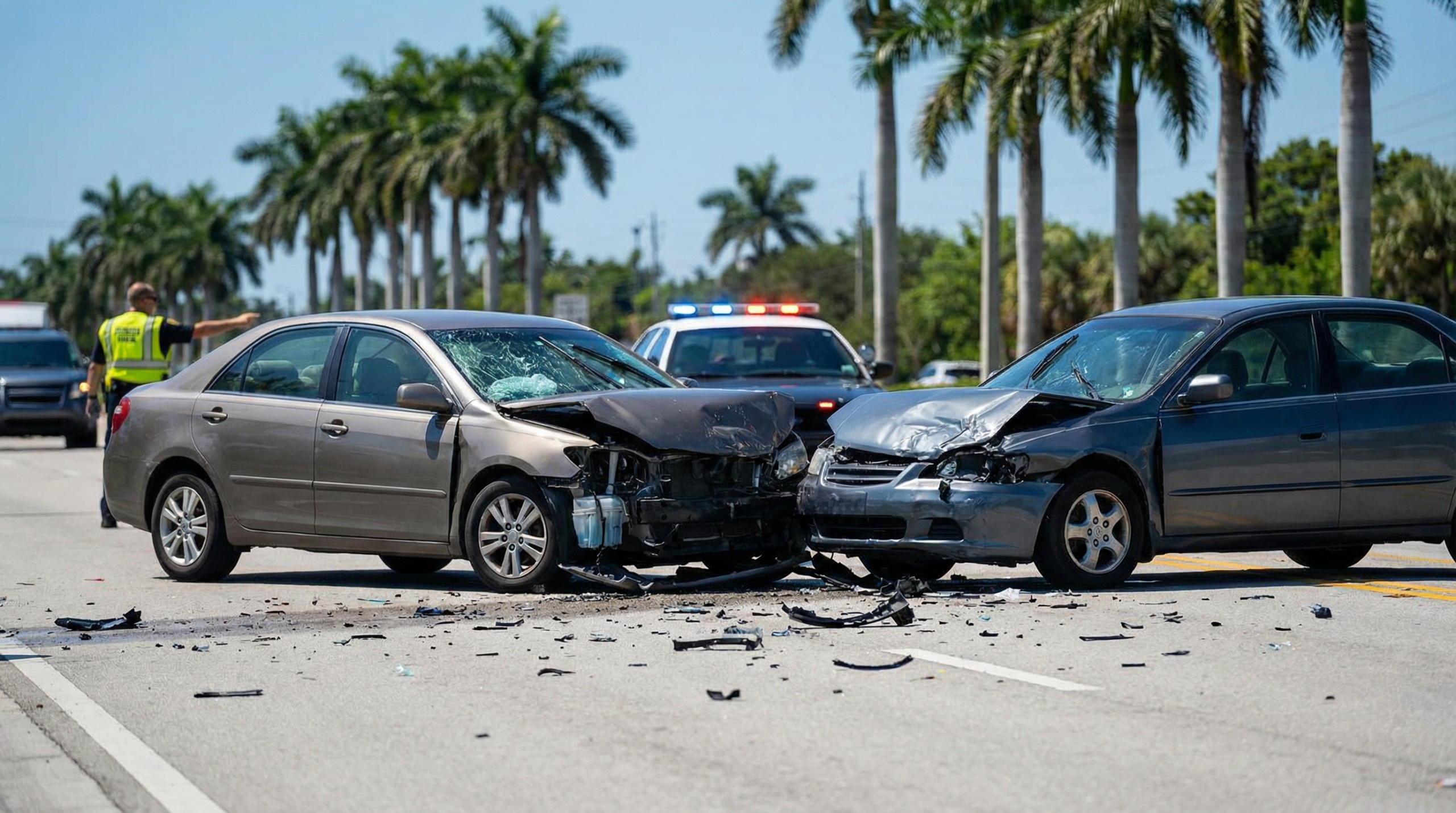
In Florida, determining fault in an auto accident involves assessing negligence, even within its no-fault insurance system. While Personal Injury Protection (PIP) covers initial medical expenses regardless of fault, liability for serious injuries or property damage often relies on proving which party failed to act with reasonable care. This process considers various factors, including traffic laws, evidence from the scene, and witness accounts, to establish responsibility.
What is Florida’s No-Fault Law and How Does it Affect Fault Determination?
Direct Answer:
Florida’s no-fault law mandates that drivers carry Personal Injury Protection (PIP) insurance, which covers their own medical expenses and lost wages up to a certain limit, regardless of who caused the accident. This system aims to streamline minor accident claims by reducing the need to prove fault for initial injury costs. However, it does not eliminate fault determination entirely, especially for significant damages or serious injuries that exceed PIP coverage.
Supporting Explanation:
Under Florida Statute §627.736 [1], every driver must have PIP coverage. This means that after an accident, your own insurance company typically pays for your initial medical treatment and a portion of your lost wages, up to $10,000. This system is designed to provide quick access to benefits without the delay of determining fault. However, if your injuries are severe enough to meet Florida’s “serious injury threshold,” you may be able to step outside the no-fault system and pursue a claim against the at-fault driver for additional damages, such as pain and suffering. This is where proving fault becomes crucial, as it directly impacts your ability to recover compensation beyond your PIP benefits. The no-fault system primarily addresses immediate medical costs, but for more extensive losses, fault remains a central legal consideration.
How Does Comparative Negligence Impact Car Accident Claims in Florida?
Direct Answer:
Florida operates under a modified comparative negligence rule, meaning that if you are found to be 51% or more at fault for an accident, you are generally barred from recovering any damages from the other party. If you are 50% or less at fault, you can still recover damages, but the amount will be reduced proportionally to your percentage of fault. This rule makes accurate fault determination critical for any personal injury claim.
Supporting Explanation:
Prior to March 2023, Florida followed a pure comparative negligence standard, allowing injured parties to recover some damages even if they were mostly at fault. The shift to modified comparative negligence, outlined in Florida Statute §768.81 [2], significantly impacts how accident claims are handled. For example, if a jury determines your total damages are $100,000, but you were 20% at fault, your recoverable compensation would be reduced to $80,000. However, if you were found 55% at fault, you would receive no compensation. This legal framework incentivizes insurance companies to try and assign a higher percentage of fault to the injured party, underscoring the importance of a thorough investigation and strong legal representation to protect your right to compensation.
What Evidence is Used to Determine Fault in a Florida Car Accident?
Direct Answer:
Determining fault in a Florida car accident involves a comprehensive review of various types of evidence. This includes physical evidence from the scene, such as vehicle damage and skid marks; documentary evidence like police reports, medical records, and cell phone data; and human elements, including eyewitness statements and expert testimony. Each piece of evidence helps to reconstruct the accident and establish negligence.
Supporting Explanation:
Police reports, while not always admissible as sole evidence of fault in court, provide an initial assessment and often include crucial details like traffic citations. Physical evidence, such as the location and type of vehicle damage, accident scene photos, and even “black box” data from modern vehicles, can reveal impact angles, speeds, and driver actions. Medical records directly link injuries to the accident, while cell phone records can indicate distracted driving. Surveillance footage from traffic cameras or nearby businesses offers an impartial view of the incident. In complex cases, accident reconstructionists and medical experts may provide testimony to clarify how the accident occurred and the extent of injuries. Gathering and analyzing this evidence is essential for building a strong case and accurately assigning fault.
Are There Common Scenarios Where Fault is Typically Assigned in Florida?
Direct Answer:
In Florida, certain accident scenarios often lead to a typical assignment of fault. For instance, the driver who rear-ends another vehicle is usually considered at fault due to the legal requirement to maintain a safe following distance. Similarly, the driver making a left turn is frequently found responsible in collisions with oncoming traffic, as they are generally required to yield the right-of-way. However, exceptions can apply based on specific circumstances and contributing factors.
Supporting Explanation:
For rear-end collisions, Florida law generally presumes the trailing driver is negligent for failing to maintain a safe distance, as per Florida Statute §316.089 [3]. Exceptions might include the lead driver braking suddenly without reason or having non-functional brake lights. In left-turn accidents, Florida Statute §316.122 [4] dictates that the turning vehicle must yield to oncoming traffic, making them typically at fault. However, if the oncoming driver was speeding excessively or ran a red light, fault could be shared or shifted. Intersection accidents, often referred to as “T-bone” collisions, usually assign fault to the driver who failed to obey a traffic signal or sign. These common scenarios provide a general guideline, but a thorough investigation of all contributing factors is always necessary to determine precise fault.
Key Takeaways:
- Florida’s no-fault system covers initial medical costs via PIP, but fault is crucial for serious injuries or damages beyond PIP limits.
- Modified comparative negligence means you may not recover damages if you are 51% or more at fault.
- Evidence like police reports, vehicle damage, medical records, and witness statements are vital for proving fault.
- Common accident types, like rear-end and left-turn collisions, have typical fault assignments, but exceptions exist.
FAQ Section:
FAQ 1: Does Florida’s no-fault law mean I can’t sue after a car accident?
Direct Answer:
Florida’s no-fault law primarily means your own Personal Injury Protection (PIP) insurance covers initial medical expenses and lost wages, regardless of who caused the accident. However, if your injuries are severe enough to meet the state’s “serious injury threshold,” you may still be able to pursue a personal injury claim against the at-fault driver for damages beyond what PIP covers, such as pain and suffering. This is when fault becomes a critical factor.
FAQ 2: What is the 51% rule in Florida car accident claims?
Direct Answer:
Florida’s 51% rule refers to its modified comparative negligence law. If you are found to be 51% or more responsible for causing a car accident, you are legally barred from recovering any compensation from the other party. If your fault is determined to be 50% or less, you can still recover damages, but the total amount will be reduced proportionally to your percentage of fault.
FAQ 3: How long do I have to file a car accident lawsuit in Florida?
Direct Answer:
In Florida, the statute of limitations for most car accident personal injury lawsuits is two years from the date of the accident. This deadline was changed in March 2023 from the previous four-year limit. It is crucial to consult with an attorney promptly after an accident to ensure your claim is filed within the legal timeframe, as missing this deadline can result in losing your right to seek compensation.
FAQ 4: Can a police report solely determine fault in a Florida car accident?
Direct Answer:
While a police report provides an initial assessment and valuable information about a car accident, it is generally not the sole determinant of fault in a Florida court. Police reports are often considered hearsay and are based on immediate observations and statements at the scene. A comprehensive fault determination typically involves gathering additional evidence, such as witness statements, vehicle damage analysis, and expert testimony, to build a complete picture of negligence.
Seeking Legal Guidance After a Florida Auto Accident?
Navigating the complexities of Florida’s auto accident laws can be challenging, especially when dealing with injuries and insurance companies. Understanding how fault is determined is crucial for protecting your rights and securing the compensation you may deserve. If you’ve been involved in a car accident and have questions about your specific situation, seeking professional legal advice can provide clarity and strategic direction. An experienced personal injury attorney can help you gather evidence, understand the nuances of comparative negligence, and advocate on your behalf to ensure a fair outcome.
Contact Gagliano Law, PLLC Today
If you or a loved one has been involved in a Florida auto accident, do not navigate the legal process alone. The team at Gagliano Law, PLLC, led by attorney Amanda Gagliano, is dedicated to providing comprehensive legal support for personal injury cases. We understand the intricacies of Florida law and are committed to fighting for your rights. Contact us today for a consultation to discuss your case and learn how we can help you. Call us at 813-444-9724 or visit our contact page at https://lawgagliano.com/contact/ to schedule your free consultation.
Disclaimer: This article is for informational purposes only and does not constitute legal advice. Every case is unique, and you should consult with a qualified attorney for advice tailored to your specific situation.
References
- Florida Statute §627.736, Florida Motor Vehicle No-Fault Law. https://www.leg.state.fl.us/Statutes/index.cfm?App_mode=Display_Statute&URL=0600-0699/0627/Sections/0627.736.html
- Florida Statute §768.81, Comparative Fault. https://www.leg.state.fl.us/Statutes/index.cfm?App_mode=Display_Statute&URL=0700-0799/0768/Sections/0768.81.html
- Florida Statute §316.089, Following too closely. https://www.leg.state.fl.us/Statutes/index.cfm?App_mode=Display_Statute&URL=0300-0399/0316/Sections/0316.089.html
- Florida Statute §316.122, Vehicle turning left. https://www.leg.state.fl.us/Statutes/index.cfm?App_mode=Display_Statute&URL=0300-0399/0316/Sections/0316.122.html
Related Posts