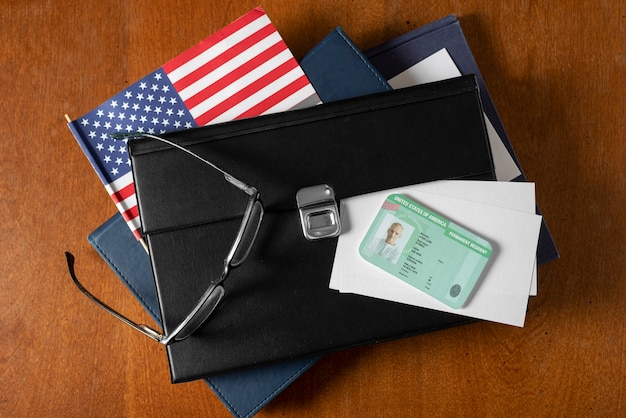
A marriage-based Green Card approval is a big milestone. However, if you were married for less than two years when your residency was approved, USCIS issued you a Conditional Permanent Resident Card valid for only two years. To keep your legal status, those conditions must be removed before your card expires. So, what is I-751 Form, and why is it so critical to your immigration status?
In this guide, you will learn what Form I-751 is, in which situations to file it, how the process works, and what to do if your life situation has changed since filing it.
Key Takeaways
- 90-Day Filing Window – Joint filings must be received by USCIS during the 90 days immediately prior to your conditional card expiring. If you file too early (or late), your application can be rejected or outright terminated.
- Establishing a “Good Faith” Marriage: You need to provide ongoing proof of your marriage for the full 2 years, such as joint bank accounts, leases together, taxes filed jointly, and children’s birth certificates.
- Automatic Extension: You receive a receipt notice with Form I-797 from USCIS after submitting your properly filed Form I-751, which automatically extends your permanent resident status while the petition is pending.
- Waiver Eligibility: Form I-751 can be filed independently at any time using this waiver to lift the conditions in the event of divorce, widowhood, or abuse.
What Is I-751 Form?
What is I-751 Form? Form I-751 (Petition to Remove Conditions on Residence) upgrades your temporary 2-year conditional Green Card to a permanent 10-year card.
- Why it exists: USCIS checks in after two years to verify your marriage is real—not just a shortcut for immigration benefits.
- The risk: Missing your 90-day filing window automatically revokes your legal status and can trigger deportation proceedings.
When Should You File Form I-751?
Timing depends entirely on whether you are filing jointly with your spouse or requesting an individual waiver.
1. Joint Filings (Filing with Your Spouse)
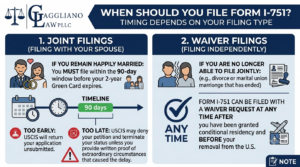
If you remain happily married, you must file within the 90-day window before your 2-year Green Card expires.
- Too Early: USCIS will return your application unsubmitted.
- Too Late: USCIS may deny your petition and terminate your status unless you provide written proof of extraordinary circumstances that caused the delay.
2. Waiver Filings (Filing Independently)
If you are no longer able to file jointly with your spouse, you don’t need to wait the 90 days. Whereas, after you have been granted conditional residency for a divorce or marital union marriage that has ended in divorce (disruption of the marital union), Form I-751 can be filed with a waiver request at any time and before your removal from the U.S.
Get Legal Advice, Schedule Your Consultation
Contact Us Today!
What Evidence Is Required for Form I-751?
As a conditional resident married for 2 years to your spouse, USCIS expects solid evidence of you both creating a life together. Strong supporting documentation includes:
- Finances: Joint bank statements, joint tax returns, joint credit card statement, and utility bills.
- Shared Housing: Both names on a lease, mortgage, property deed at the same address
- Insurance & Legal Policies: Joint health, auto or life insurance policies, championing each other as primary beneficiaries.
- Birth certificates (or legally comparable documents) for children born during the marriage or adoption decrees
- Photos of the couple together over time as well as photos with family and friends; trip itineraries, affidavits from friends or family confirming that your marriage is legitimate.
How Does the Form I-751 Process Work?
Removing conditions on your Green Card follows a multi-step administrative path.
Step 1: Prepare and Submit Your Packet
Gather Form I-751, other filing fees, and proof of a bona fide marriage. A full package is sent to the corresponding USCIS Lockbox facility based on where you live.
Step 2: Get Your Form I-797 Extension Notice
A receipt notice (Form I-797) is sent by USCIS in a matter of weeks. This document is an official confirmation of your work status, travel approval, and legal verification as you wait for the case to be processed.
Step 3: Attend Your Biometrics Appointment
As your case progresses, USCIS may ask you to appear at a local Application Support Center (ASC) to be fingerprinted and photographed again, but in most cases they “reuse” biometrics that they already have on file.
Step 4: Interview & Final Decision
If your joint evidence is thorough, USCIS may approve your petition without an interview. If questions remain—or if you filed an individual waiver—you will be scheduled for an interview at a local USCIS field office. Upon approval, your 10-year Green Card is mailed.
What If You Are Divorced, Separated, or Abused?
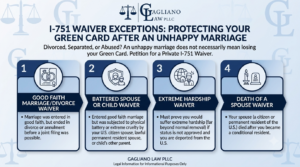
In life, things sometimes do not go as you planned, and having an unhappy marriage does not necessarily mean that you lose your Green Card. You may petition for a private I-751 Waiver in the following legally established Exceptions to the Rule:
- Good Faith Marriage/Divorce Waiver: Your marriage was in good faith, but ended in divorce or annulment before you could file jointly.
- Battered Spouse or Child Waiver: You entered the good faith marriage but have been subjected to physical battery or extreme cruelty perpetrated by your U.S. citizen spouse, lawful permanent resident spouse, other parent of your child, 18 U.S.C.
- Extreme Hardship Waiver: You must prove that you would suffer extreme hardship, far beyond what would normally be expected from removal, if your status were not approved and you were deported from the U.S.
- Death of a Spouse: Your spouse (a citizen or permanent resident of the U.S.) died after you became a conditional resident.
Get Legal Advice, Schedule Your Consultation
Contact Us Today!
Why You Need an Immigration Lawyer for Form I-751
Although a joint I-751 petition with sufficient evidence can be relatively uncomplicated, most cases are met with challenges such as processing delays, Requests for Evidence (RFE) notices, or divorce. The role of an experienced immigration attorney assists:
- Evaluating Your Own Evidence: Make sure your documents meet or exceed rigid USCIS criteria, so you skip an annoying interview and RFE.
- Using Waiver Requests Wisely: If you are filing after a divorce, separation, or an abuse case, create a rebuttable legal strategy.
- Travel & Work Authorization: Monitoring of any extensions you received so you never lose work or travel rights
- Attending your Interviews: USCIS may request that you appear in-person in cases we are representing you.
Conclusion
If you’re asking, “What is I-751 Form?”, it is also called Petition to Remove Conditions on Residence. It is the official USCIS document used by conditional permanent residents to transition from a 2-year conditional Green Card to a 10-year permanent Green Card. Filed jointly by both spouses within the 90-day window before the 2-year card expires, the form proves that the marriage was entered into in good faith rather than to bypass immigration laws. Individual waivers are available for cases involving divorce, abuse, or extreme hardship.
Frequently Asked Questions
Q: Am I allowed to travel outside the U.S. while my Form I-751 is pending?
A: Yes. You can travel abroad using your non-expired foreign passport, your unexpired conditional Green Card copy, and either the original or a photocopy of the Form I-797 receipt notice that extends status while your application is pending with immigration.
Q: If my I-751 is pending but I’ve met the eligibility requirements for citizenship, what should I do?
A: You can also file Form N-400 (Application for Naturalization) three years after acquiring permanent residence if you are still married to your spouse who is a U.S. citizen—even if your I-751 is still pending. Most of the time, USCIS will hold a combined interview to adjudicate both applications.
Q: Is a final divorce decree needed to file an I-751 waiver based on divorce?
A: Yes. USCIS would use the divorce waiver’s final approval letter in conjunction with a final judgment of dissolution of marriage. If you are separated, but not yet divorced, an attorney will help you with the proper timeline for when to file.
Q: How long will my application take to process?
A: Timeframes can range from 12 – 36 months, depending on the complexity of a case and availability at a field office. And this is the reason USCIS sends out extension notices good for up to 18 months upon receipt.
Other Service We Offered
Employment / Talent-Based Visas
O-1 Visas
PVisas
H-1B Visas
TN Status
Green Card
Adjustment of Status (AOS)
EB-5 Visa
EB-1 Visa
EB-2 National Interest Waiver (NIW)
Green Card
K-1 Visa
Investor Visas
E-2 Visa
L-1 Visa
Humanitarian
VAWA
SIJS
T Visa
U Visa
Naturalization and U.S. Citizenship