
Contemplating How to Bring Your Partner to the U.S.? You have two main options: K-1 Fiancé Visa or the CR-1 Spouse Visa. So, what is a K-1 visa? How does it differ from a CR-1 visa? The result is that you are building a life together in America, but the “how to get there: looks completely different. There is a spectrum of costs, processing times, work rights — and whether you get married before or after immigrating to the States. The choice you make is entirely dependent on how important each of these actions is to you right now: agility, money, or a work-from-the-second-you-land scenario.
Key Takeaways
- Marital Status: K-1 requires that you be engaged and marry in the U. S. within 90 days of entry; CR-1 requires you to have been legally married before submitting petitions
- CR-1 vs. IR-1: The holder of CR-1 gets his Green Card as soon as he or she arrives. As a nonimmigrant, K-1 holders must apply for a Green Card in a separate application after the fact – not as part of their marriage.
- CR-1 spouses: From day 1, CR-1 spouses can work and travel internationally. Those who hold a K-1 will be required to remain in limbo for months, as they wait for an Employment Authorization Document (EAD) and travel permission via Advance Parole.
- Total Cost: K-1 appears cheaper in the short term, but it is usually pricier overall due to mandatory USCIS filing fees after entering for Adjustment of Status.
What Is a K-1 Visa?
So, what is a K-1 visa? How does it differ from a CR-1 visa? A nonimmigrant visa for a U.S. citizen’s fiancé(e), known as a K-1 Fiancé(e) Visa. It gives your partner a legal route to obtaining entry into the United States: the ability to marry you.
What Are The Basic Requirements for a K-1 Visa?
- USC (U.S. Citizen Only): A fiancé(e) petition can not be filed by a Lawful Permanent Resident; the petitioner must be a U.S.
- Provide Evidence of Your In-Person Meeting Rule: Every spouse is required to demonstrate that he or she met the other in person at least once during the two years prior to submitting your Form I-129F application.
- Intent to Marry: Two sworn statements by partners indicating they plan to marry in the United States within 90 days of entrance into the U.S.
- 90 Day Marriage Requirement: Wedding to be held within 90 days of the foreign fiancé(e) entering the United States.
- Adjustment of Status (AOS): The foreign spouse must then apply for their permanent residency status (Green Card holder) by filing Form I-485 post-marriage.
What Is a CR-1 Visa?
CR-1| Conditional Resident: An Immigrant Visa for a foreign spouse of a U.S. Citizen, When Less than 2 Years Of Marriage Is Established At the Time Of Issuance If you are married for more than 2 years at the time your case is granted, then your wife will be given an IR-1 (Immediate Relative) Visa.
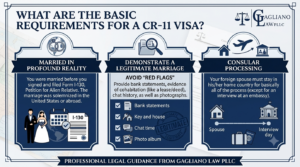
What Are The Basic Requirements for a CR-11 Visa?
- Married in Profound Reality: You were married before you signed and filed Form I-130, Petition for Alien Relative. The marriage was solemnized in the United States or abroad.
- Red Flags: You must demonstrate that the marriage is legitimate by providing bank statements, evidence of cohabitation, chat history, as well as photographs.
- Consular Processing: Your foreign spouse must stay in his/her home country for basically all of the process (except for an interview at an embassy).
Get Legal Advice, Schedule Your Consultation
Contact Us Today!
How Does a K-1 Visa Differ from a CR-1 Visa?
Comparing both paths side-by-side highlights how they affect your immediate and long-term future:
| Feature | K-1 Fiancé Visa | CR-1 Spouse Visa |
| Marital Status at Filing | Engaged (Not Married) | Legally Married |
| Status Upon U.S. Entry | Nonimmigrant (Fiancé) | Lawful Permanent Resident (Green Card Holder) |
| Work Authorization | Delayed; must apply for EAD alongside Green Card | Immediate upon U.S. entry |
| International Travel | Restricted until Advance Parole is granted | Full travel freedom from day one |
| Secondary Filing Required? | Yes (Form I-485 Adjustment of Status after marriage) | No (Green Card is processed abroad) |
| Total Government Cost | Higher overall (Petition + AOS filing fees) | Lower overall (Consular processing fees only) |
Which Visa Pathway Is Right for You?
Selecting between the K-1 and CR-1 pathways depends heavily on your priorities as a couple.
A K-1 Visa May Be Best If:
- For the first, you prefer to hold your wedding inside the United States.
- Moreover, your only focus is getting your partner to the U.S. as soon as you can take a temporary job and are limited on travel once they arrive.
- Third, you are not yet legally married and would like to travel for a wedding before your entry.
Conversely, a CR-1 Visa Might Be Better Suited If:
- First, you either currently married or intend to marry abroad soon.
- Plus, you want your spouse to be authorized with the ability to work and travel abroad as soon as they are in the U.S.
- So, to sum up, you want a simple process of a one-phase application with a low total fee paid by the government.
Average Processing Times & Timelines
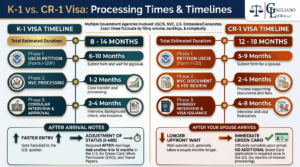
Processing times for both visa pathways involve multiple government agencies—USCIS, the National Visa Center (NVC), and local U.S. embassies or consulates. Exact wait times fluctuate depending on filing volume, embassy backlogs, and case complexity.
K-1 Visa Timeline
- Total Estimated Duration: 8 to 14 months
- Phase 1: The USCIS Petition (Form I-129F): 6-10 months
- Phase 2: Processing NVC: 1–2 months
- Phase 3: Consular interview & Approval of Visa: 2-4 Months
- Notes After Arrival: The K-1 will allow your fiancé(e) to enter the U.S. faster, it is true, BUT he/she will still need to go through the Adjustment of Status process (I-485 application) AFTER marriage. Add another 6 to 12 months of time waiting in the U.S. for an approval on a green card, work permission (EAD), and travel papers (Advance Parole).
CR-1 Visa Timeline
- Overall Estimated Duration: 12 to 18 months
- Phase 1: Petition USCIS (I-130): 5 to 9 months
- Phase 2 Phase 2: NVC Document & Fee Review (2 – 4 months)
- Phase 3: Embassy interview and visa issuance — 4 to 8 months
- After Your Spouse Arrives: The CR-1 process is officially only complete when your spouse physically arrives, but the wait outside of the U.S. will have taken a couple months longer upfront (generally). No additional green card application is required once in the US–not going to have months of processing from within the country.
Get Legal Advice, Schedule Your Consultation
Contact Us Today!
Do You Need an Immigration Lawyer?
Immigration forms, evidence requirements, and changes in policy may lead to unplanned delays or an expensive error in an application. An experienced immigration attorney provides you with the following points of advice:
- Choosing a strategy: You select the best visa pathway for your personal timeline and financial goals.
- Document Precision: Your proof for marriage, taxes, and petitions is formatted to meet the rigorous USCIS and State Department requirements.
- Gap Avoidance: You maneuver through the Adjustment of Status process without fear of status abuse or travel snafus.
Conclusion
We now have answers to “what is a K-1 visa?” The K-1 Visa enables the foreign fiancé(e) of a U.S. citizen to travel to the U.S. with the condition that marriage takes place within 90 days of arriving. The foreign partner applies for a Green Card through Adjustment of Status after marriage. The CR-1 Visa allows couples to get married only and also before applying. The overseas wait time may be longer at first. However, by the time the foreign spouse steps onto U.S. soil, they are a permanent resident (green card holder) ready to work and travel without delay.
Frequently Asked Questions
Q: Is it possible for Lawful Permanent Residents (Green Card holders) to file a K-1 Fiancé Visa?
A: No. Only U.S. citizens can file a K-1 petition for a fiancé(e). Permanent residents must first marry and then apply for their spouse under the F2A spousal visa.
Q: Is my K-1 fiancé automatically granted a work permit when he/she arrives in the US?
A: No. The K-1 visa gives you the right to stay for 90 days and marry; however, your spouse cannot work until she or he files Form I-765 (Employment Authorization) in conjunction with an Adjustment of Status application and is granted employment authorization approval.
Q: Suppose we filed a K-1 but later are married before the interview?
A: You’re not “fiancés” anymore, so you no longer have a K-1 petition once you are married. If you Changed your mind you Would have to withdraw the I-129F and restart the entire process again using an I-130 To apply for a CR-1 Spouse Visa.
Q: Does the CR-1 Visa issue a 2-year or a 10-year Green Card?
A: If the marriage was less than two years at approval/admission of their CR-1, then spouses are granted a Conditional 2-year Green Card. If it is a two-year or longer marriage, then the couple gets a 10-Year Green Card (IR-1 status).
Other Service We Offered
Employment / Talent-Based Visas
O-1 Visas
PVisas
H-1B Visas
TN Status
Green Card
Adjustment of Status (AOS)
EB-5 Visa
EB-1 Visa
EB-2 National Interest Waiver (NIW)
Green Card
K-1 Visa
Investor Visas
E-2 Visa
L-1 Visa
Humanitarian
VAWA
SIJS
T Visa
U Visa
Naturalization and U.S. Citizenship